
The first question many of our clients ask is: “Can B2B companies use TikTok, too? Will we be able to close big deals?” In this episode, we’ll share case studies of B2B companies monetizing on TikTok, with the hope that everyone can be among the first to try it out and ride the wave of cross-border e-commerce.
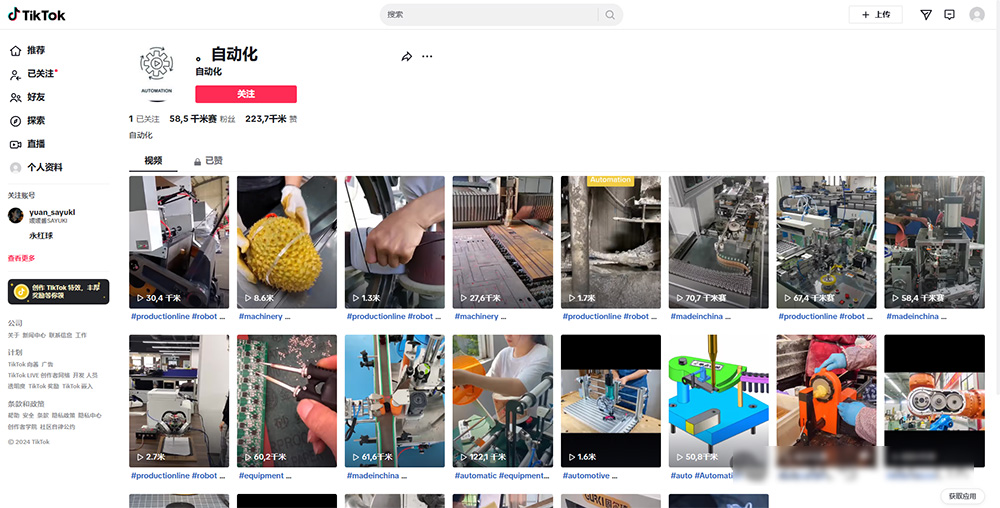
Today, we’re featuring a manufacturer of lathes that has 50,000 followers and over 200,000 likes on TikTok. Let’s take a look at how they manage their TikTok account.

The opening viral video was filmed in a factory production line, with the presenter demonstrating how to use a sample product in a fun and lively way; it has garnered millions of views on TikTok.
Most of the comments below express interest.
The requirements for video footage aren’t as high as people might think. You can shoot it right in the factory—for example, the production process, the products themselves, or anything that might pique people’s interest or enhance the viewing experience. If all else fails, just search for popular videos and follow their approach to create your own.
For beginners, the easiest and most efficient approach is to copy others’ content—you never know which video might go viral and bring in a significant amount of traffic.
The next step in monetizing your traffic is to refine your profile.
On our own website, we can include contact information such as phone numbers, email addresses, Instagram, Line, WhatsApp, and more. The ultimate goal is to convert website traffic into orders.
Next, we’ll share a related industry report with you.
According to data compiled by the General Administration of Customs, China’s construction machinery import and export trade volume totaled $51.063 billion in 2023, representing a year-over-year increase of 8.57%.
Among these, exports of construction machinery continued to grow, while imports showed a narrowing decline. In 2023, China’s exports of construction machinery products reached $48.552 billion, a year-over-year increase of 9.59%. Imports totaled $2.511 billion, down 8.03% year-over-year; the year-to-date decline in import value narrowed from 19.8% to 8.03% by the end of the year. The trade surplus stood at $46.04 billion, an increase of $4.468 billion year-over-year.
In terms of export categories, exports of finished products outperformed exports of components. In 2023, cumulative exports of finished products totaled $34.134 billion, a year-over-year increase of 16.4%, accounting for 70.3% of total exports; exports of components totaled $14.417 billion, accounting for 29.7% of total exports, a year-over-year decrease of 3.81%. The growth rate of finished product exports exceeded that of component exports by 20.26 percentage points.
01: Overall export performance has been mixed
Exports to the Russian Federation, India, Africa, and Latin America are high and growing rapidly
In 2023, China’s exports of construction machinery to various continents saw positive growth in exports to Asia, Europe, South America, and Africa, while exports to North America and Oceania declined. The specific details are as follows:
Exports to Asia totaled $19.649 billion, up 7.61% year-over-year;
Exports to Europe totaled $12.689 billion, a year-over-year increase of 22.21%;
Exports to North America totaled $5.12 billion, down 7.21% year-over-year;
Exports to South America totaled $4.538 billion, a year-over-year increase of 10.11%;
Exports to Africa totaled $4.475 billion, a year-over-year increase of 15.61%;
Exports to Oceania totaled $2.078 billion, a year-over-year decrease of 3.17%.
Exports to Countries Along the "Belt and Road"
In 2023, China’s exports of construction machinery to countries along the “Belt and Road” route totaled $21.055 billion, a year-over-year increase of 24.1%, accounting for 47.2% of total exports and maintaining a strong growth momentum.
Among exports to major regional economies, exports to Africa, Latin America, the Russian Federation, and India showed positive growth; exports to ASEAN, the European Union, and the three major economies of the U.S.-Canada-Mexico Free Trade Agreement (USMCA) declined. Weak demand from these three major economies was the primary driver behind the decline in China’s construction machinery exports in the second half of the year. The specific details are as follows:
Exports to Africa and Latin America totaled $9.013 billion, a year-over-year increase of 12.8%, accounting for 18.56% of total exports.
Exports to the Russian Federation totaled $6.058 billion, a year-over-year increase of 66.5%, accounting for 12.48% of total exports;
Exports to India totaled $1.78 billion, a year-over-year increase of 20.3%, accounting for 3.67% of total exports;
Exports to ASEAN totaled $7.16 billion, down 10.2% year-over-year, accounting for 14.75% of total exports.
Exports to the EU and the United Kingdom totaled $6.265 billion, down 2.97% year-over-year, accounting for 12.9% of total exports;
Exports to the U.S.-Canada-Mexico Free Trade Area totaled $6.038 billion, down 0.73% year-over-year, accounting for 12.44% of total exports;
Among the world’s major export destinations, the combined export value of the top 20 countries and regions accounted for 66.87% of total exports.
Among them, annual exports to a total of twelve countries and regions (the Russian Federation, the United States, Indonesia, Japan, Australia, India, Brazil, Belgium, Saudi Arabia, Turkey, South Korea, and Thailand) exceeded $1 billion;
Among the top 50 countries and regions by export value, the Maldives, Algeria, Kyrgyzstan, Turkey, Mongolia, Tajikistan, Uzbekistan, the Russian Federation, Laos, Mexico, and the United Arab Emirates all saw growth rates exceeding 50%.
02: Specific Export Destinations for Major Products
Above, we have examined the overall export destinations for construction machinery, with the Russian Federation, the United States, Indonesia, Japan, Australia, and India ranking as the top six export destinations. Below, we will examine the specific export destinations by product category.
In 2023, the major target markets for China’s major categories of construction machinery products, ranked by export value:
The main export destinations for excavators include: Russia, Belgium, Indonesia, the United States, Turkey, Saudi Arabia, the Philippines, Vietnam, the United Kingdom, the Netherlands, and others; exports from each of these countries exceeded $200 million;
The main export destinations for loaders include: Russia, the United States, Belgium, Brazil, Australia, Kazakhstan, Saudi Arabia, Indonesia, South Africa, and others—the export value from each of these countries exceeded $80 million;
The main export destinations for bulldozers are the Russian Federation and Indonesia, among others, with export values to both countries exceeding $80 million;
The main export destinations for truck-mounted cranes include: Russia, India, Brazil, Saudi Arabia, the United Arab Emirates, Indonesia, Kazakhstan, Thailand, etc.;
Crawler cranes are mainly exported to: India, Indonesia, Russia, Singapore, Hong Kong, China, South Korea, Australia, Turkey, the United Arab Emirates, etc.;
Tower cranes are primarily exported to:Turkey, Russia, Singapore, South Korea, the United Arab Emirates, Uzbekistan, Taiwan, China, etc.;
The main export destinations for forklifts are:Russia, the United States, the Netherlands, Australia, Brazil, Mexico, Belgium, Canada, Turkey, Germany, Thailand, India, South Korea, the United Kingdom, Malaysia, Indonesia, France, Saudi Arabia, Italy, etc.;
The main export destinations for rock drilling machinery and pneumatic tools are:The United States, Russia, Malaysia, Brazil, Vietnam, Singapore, India, Saudi Arabia, Mexico, South Korea, Australia, and others;
Tunnel boring machines are mainly exported to:Italy, South Korea, Australia, India, Thailand, Russia, Taiwan, China, Singapore, Brazil, etc.;
The main countries to which road rollers are exported include:The United States, Russia, Australia, Indonesia, Saudi Arabia, the Philippines, Brazil, Belgium, and others;
The main export destinations for pavers are:The United States, Russia, Saudi Arabia, Brazil, Italy, Vietnam, India, and others;
The main export destinations for off-highway dump trucks are:Russia, Indonesia, Mongolia, the Democratic Republic of the Congo, Uzbekistan, South Africa, Saudi Arabia, Laos, Malaysia, Kazakhstan, the United Arab Emirates, Brazil, Thailand, India, Tajikistan, etc.;
The main countries to which parts are exported include:The United States, Japan, Russia, Australia, India, South Korea, Indonesia, Brazil, Canada, the United Kingdom, Italy, Thailand, Germany, Malaysia, Vietnam, the United Arab Emirates, and others.
03: Analysis of Domestic Sales of Excavators and Loaders by Region
In 2023, the top ten regions by excavator sales were: Jiangsu, Guangdong, Sichuan, Anhui, Shandong, Zhejiang, Xinjiang, Yunnan, Jiangxi, and Hubei. Among these, only two provinces—Jiangsu (6,294 units) and Guangdong (5,520 units)—had annual sales exceeding 5,000 units.
The top 10 regions by loader sales in 2023 were: Shanxi, Inner Mongolia, Shandong, Hebei, Shaanxi, Jiangsu, Xinjiang, Henan, Fujian, and Zhejiang. Among these, four provinces—Shanxi (3,819 units), Inner Mongolia (3,808 units), Shandong (3,691 units), and Hebei (3,607 units)—recorded annual sales exceeding 3,000 units.
A comparison of the two sets of data above reveals significant differences in demand for excavators and loaders across regions; among the top five regions by sales volume, only Shandong is common to both lists.
At present, the outlook for China’s construction machinery industry remains bleak. It is unclear when the domestic market will bottom out; although China’s construction machinery exports continue to show positive growth, competition in the international market is intensifying, and trade protectionism is on the rise, creating a very challenging environment for China’s construction machinery trade.
Under these circumstances, construction machinery companies should remain grounded in the new stage of development, implement the new development philosophy, and build a new development paradigm; they should steadily advance the internationalization of China’s construction machinery industry and strive to propel the country’s construction machinery exports into a new phase of high-quality development.