
Abstract:Acquiring international customers on Facebook isn’t just about “posting a few updates every day”; it’s a systematic process involving “targeted content delivery → building trust on your Page → converting inquiries into sales.” This article breaks down the complete path for international trade companies to generate overseas inquiries via Facebook in 2026—from page infrastructure and content strategy to targeted traffic generation and the conversion funnel—to help B2B companies truly turn followers into customers.
Key Findings (Read This First)
For foreign trade companies, the key to acquiring customers on FacebookIt’s not about the number of followers, but whether you can consistently reach your target buyers and build trust with them.. The most effective approach for 2026 is a three-step closed-loop process: first, establish a solid foundation of trust on your homepage; second, attract targeted traffic with “problem-solving content”; and finally, convert inquiries through direct messages and WhatsApp. All three steps are essential—it’s difficult to achieve results by focusing on just one of them.
- The Homepage Is the Starting Point for Trust: Before contacting you, overseas buyers will definitely check whether your homepage looks authentic and professional.
- Content Determines Reach: Posting product photos rarely generates inquiries; only content that solves buyers' problems will get engagement and be shared.
- Conversion Depends on Funnel Design: From comments and private messages to WhatsApp, every step requires clear scripts and guidance.
Is Facebook Still Effective for Acquiring International Customers? Where Are the Opportunities in 2026?
Conclusion: It remains effective, but the extensive approach to operations has failed.
According to Statista’s statistics based on Meta’s financial reports, Facebook’s global monthly active users exceeded 3 billion in the fourth quarter of 2023, covering major foreign trade markets such as Europe, the United States, Southeast Asia, and the Middle East. For B2B foreign trade companies, this means that target buyers are highly likely to be on the platform; the question is whether you can be seen and trusted by them.
There are two key changes to watch for in 2026: First, competition for organic reach is intensifying, making it difficult for accounts that simply post product information to gain visibility; second, AI search is on the rise, and buyers are increasingly turning to AI tools to research suppliers. This requires that foreign trade content not only be indexed by search engines but also feature a clear structure and accurate facts, making it easy for AI platforms to crawl and reference.
Why Haven't You Received Any Inquiries from Your Facebook Campaign?
Most foreign trade companies fail to see results from their Facebook efforts, typically getting stuck at the following four stages:
- The website doesn't look like that of a legitimate supplier.: Incomplete information, random profile pictures, and no contact details—buyers will just take one look and leave.
- The content speaks for itself: They only provide product specifications and quotes, without addressing the question “Why should I choose you?” from the buyer’s perspective.
- Traffic is not targeted: Most followers are either industry peers or unrelated users; while it may seem lively, there is no genuine purchasing demand.
- No conversion action: When someone sends a private message but no one responds promptly, or when a response is given but the conversation isn't directed to a channel where a sale can be made, such as WhatsApp or email.
Related Reading:Why Should Foreign Trade Companies Engage in Overseas Social Media Marketing?
Step 1: Building Your Homepage—Convincing Buyers That You Are a Genuine Supplier
Your homepage is the first thing overseas buyers look at to determine whether you are trustworthy. We recommend checking each item on the following checklist:
- Profile Picture and Cover Photo: Use the company logo and real photos of the factory, production facilities, and team; avoid using blurry or stock images.
- About Introduction: In one or two sentences, clearly explain “who you are, what you do, and which markets you serve,” and naturally incorporate core keywords, such as “ISO-certified manufacturer” and “exports to 20+ countries.”
- contact details: Fill in your website, email address, phone number, and WhatsApp information completely, and enable the "Send Message" button on your homepage.
- Homepage Verification: Complete Facebook Page verification to display the verification badge and significantly boost trust.
- Pinned Content: Pin a video introducing your company or your flagship products so new visitors can get to know you right away.
Step 2: Content Strategy—What Kind of Content Will Attract Targeted Buyers?
The goal of content isn’t to “post frequently,” but rather to “be seen by the right audience and encourage them to engage.” We recommend the following content mix:
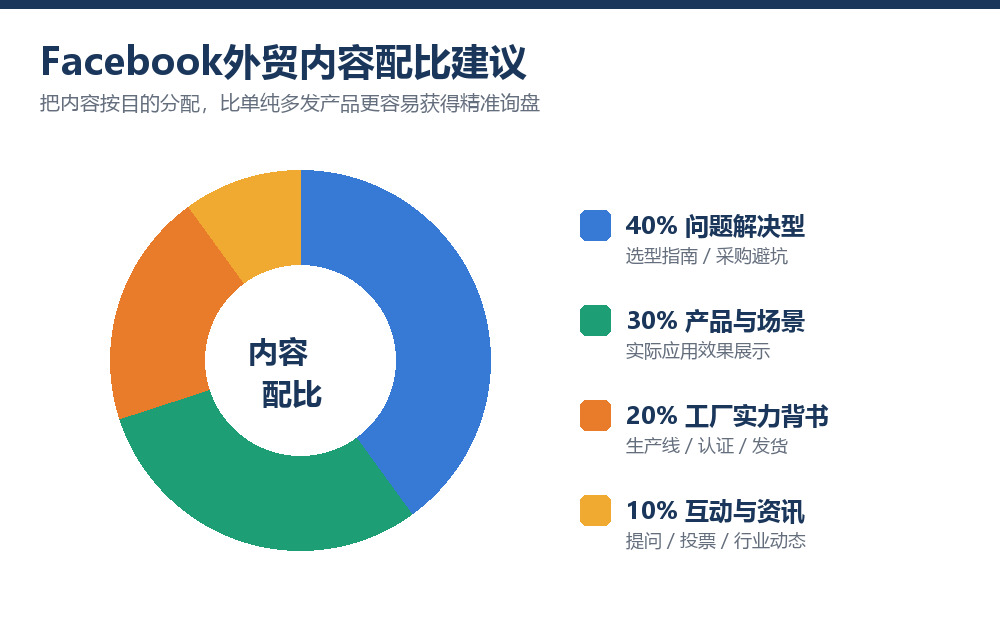
- 40% Problem-Solving Content: For example, “How to Choose a Qualified Supplier” and “Three Common Pitfalls in Procurement”—content like this is most likely to be bookmarked and shared.
- 30% Products and Application Scenarios: Demonstrate how the product performs in real-world scenarios, using real-life examples.
- 20%: Backed by the Factory's Strength: Production lines, quality inspection processes, certification documents, and shipping operations—building trust through facts.
- 10%: Interaction and Industry News: Ask questions, vote, and stay up to date on industry trends to keep your account active.
We recommend posting 3 to 5 times a week; maintaining a consistent schedule is more important than flooding the feed with posts in the short term. Try to start your copy with a single sentence that clearly states “How this content can help buyers solve a problem.” This not only improves readability but also helps search engines and AI platforms understand the main point of your content.
Image Recommendation: Add descriptive alt text to product and factory images—for example, “Actual photo of a stainless steel flange production line”—to help with image search indexing.
Step 3: Targeted Traffic Generation—How to Combine Organic Growth with Advertising
Organic OperationsIdeal for long-term growth: Join Facebook groups in your target industry and consistently share valuable content; use Reels to showcase your products and factory, gaining greater organic exposure; actively respond to comments and establish yourself as an authority by providing professional answers.
paid advertisementIdeal for rapid validation: Start by testing different creatives and audiences with a small budget to identify the combination that generates effective direct messages, then gradually scale up. A common approach is to use “lead generation ads” to collect inquiry forms and “retargeting ads” to reach users who have visited your homepage or website.
It’s important to note that as Meta’s advertising costs rise, relying solely on paid traffic is becoming less cost-effective. A more prudent approach is to combine Facebook with SEO for your independent website, so that social media traffic is directed to your own site.
Related Reading:Are Meta Ads Getting More Expensive? How Can Foreign Trade Companies Optimize Their Overseas Customer Acquisition Strategies? | How do foreign trade companies get customers through Google? The Complete Guide
Step 4: From Interaction to Inquiry—The Conversion Path from Followers to Customers
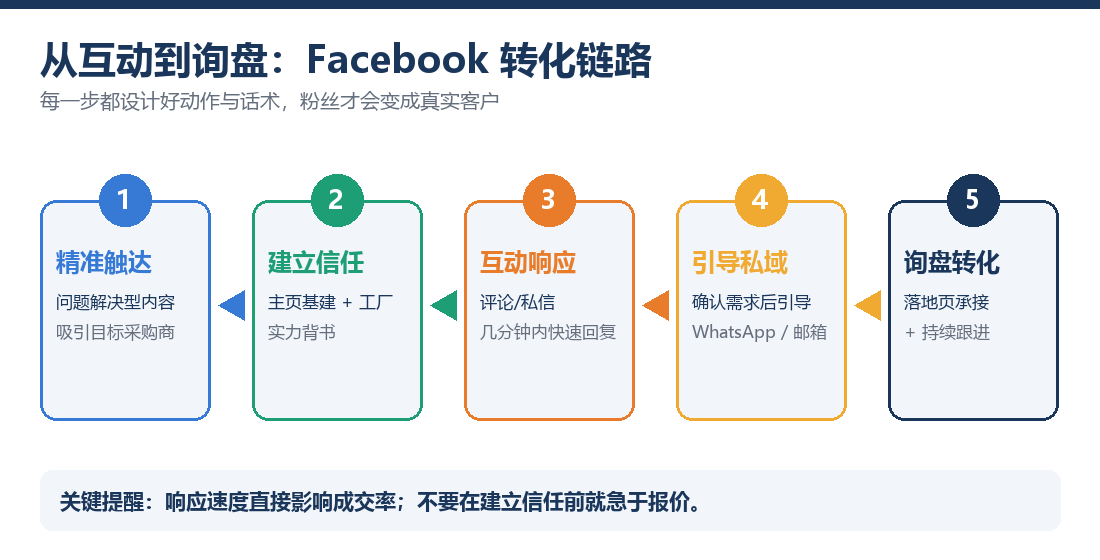
Once traffic comes in, conversions depend on a well-designed conversion funnel, not on luck:
- Quick Response: Try to reply to buyers' private messages within a few minutes; response speed directly affects the closing rate.
- Script Guidance: First, confirm the other party’s needs in a single sentence (what products they are purchasing, the quantity, and the target market), then present a proposal; do not start by giving a quote right away.
- Direct to Private Channels: Direct interested prospects to WhatsApp or email to facilitate the sending of quotes, sample information, and follow-ups.
- Landing Page Integration: Ads and traffic from the homepage should be directed to product pages or inquiry forms on your standalone website, rather than the homepage.
- Follow up regularly: Establish a follow-up routine and gradually address the buyer’s concerns by providing case studies, certificates, and delivery schedule information.
Facebook International Trade Operations Frequently Asked Questions (FAQ)
Q: How long does it take to receive inquiries when using Facebook for international trade lead generation?
Answer:There is no fixed timeline; it depends on the page’s foundation, content quality, and the pace of your efforts. Generally speaking, once you’ve completed the page’s infrastructure and filled in the content gaps (which takes about 2 to 4 weeks), you’ll typically start receiving meaningful direct messages gradually through consistent organic operations or test ads. Treating it as a long-term channel is more reliable than short-term paid traffic.
Q: What kind of content should foreign trade companies post on Facebook?
Answer:Prioritize content that addresses buyers’ concerns, such as product selection guides, tips for avoiding pitfalls during procurement, and application scenarios. Next, focus on showcasing the factory’s capabilities and real-life product photos. Simple product quotes and hard-sell ads are unlikely to generate engagement.
Q: Which is better for international trade—Facebook ads or organic reach?
Answer:The two work best together. Organic marketing is used to build trust and accumulate content over the long term, while paid advertising is used to quickly test your audience and generate initial leads. When your budget is limited, we recommend starting with organic marketing and then using a small budget to test paid advertising.
Q: How can I prevent my Facebook account or Page from being suspended?
Answer:Use accurate information and valid business credentials; avoid using automated mass-posting tools; do not post repetitive content frequently; and do not publish content that violates rules or infringes on others’ rights. Completing profile verification can also reduce the risk of being misclassified.
Q: How can I convert Facebook inquiries more quickly?
Answer:The key is response speed and communication strategy. Reply to private messages as soon as possible, confirm the customer’s needs before providing a quote, and promptly direct them to WhatsApp or email, while ensuring the independent website’s product pages are used to follow up.
concluding remarks
The success or failure of lead generation for international trade on Facebook depends on whether “trust-building” and the “conversion funnel” are treated as a systematic process. First, make your Page look professional; then, use problem-solving content to attract targeted buyers; finally, use clear messaging and a well-defined conversion path to turn interactions into inquiries. By consistently executing these four steps, Facebook can evolve from a channel that “seems lively” into one that actually generates orders.